
Boys on Film: Conversation with Emily Perry
- Maria Kaminska

- Jul 26, 2020
- 13 min read
After seeing Emily Perry's latest exhibition, 'Boys on Film' at Seventeen Gallery, I met up with her to talk about her work. We spoke about her approach to feminism, the importance of humour and authenticity, the shift from feminism into intersectionality, female role models and much more. You can find the press release for 'Boys on Film' here.
Maria Kaminska: The exhibition consists of quite a lot of different texts and media – text, video, audio, live performance – can you explain how these are all connected within the whole idea of the exhibition?
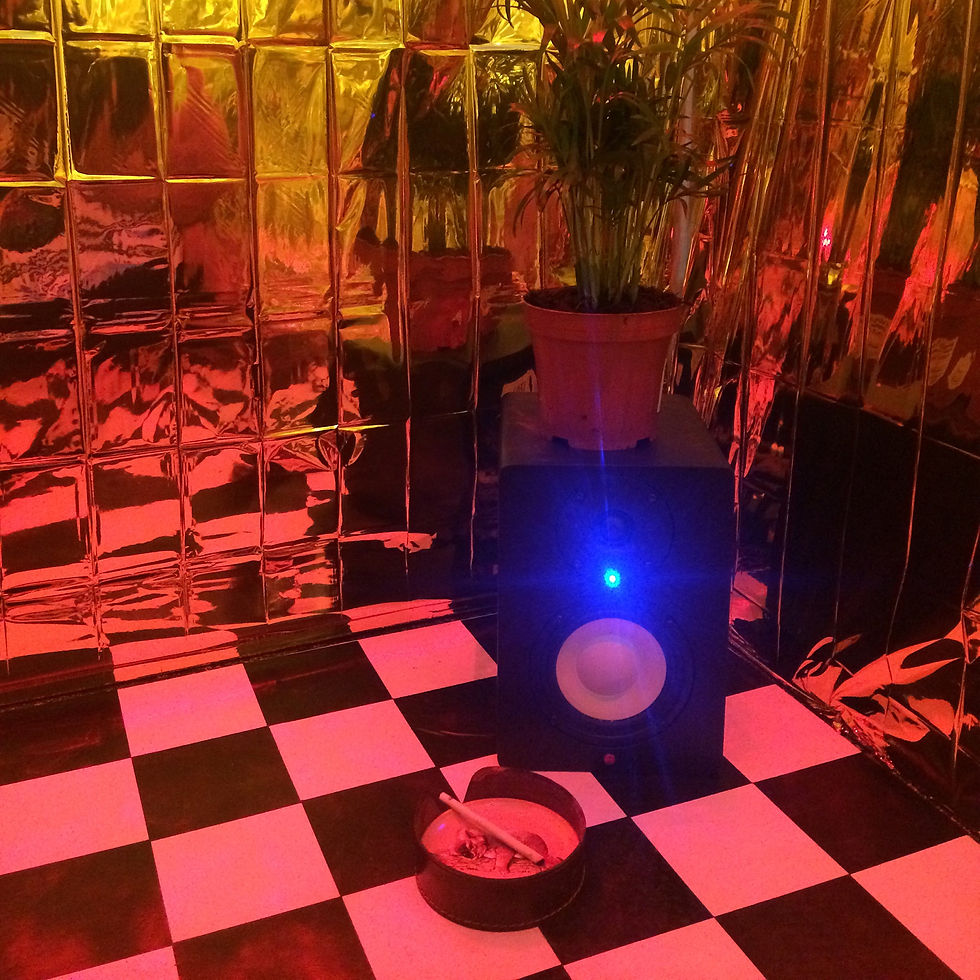
Emily Perry: The main event is the live performance, which people would come to see at a particular time. There's also silent videos, accompanied by headphones playing Amy Winehouse songs, and then there's an audio piece that plays every 20 minutes. During the performance the boys sing the chorus of Amy Winehouse’s You Know I'm No Good and perform their scripts. Outside of performance times there are speakers positioned behind the curtains in place of the performing boys. And so then the audience members become the performers because they had to kind of bend to listen to them, they were sort of putting their ear to the hole rather than the boys putting their mouth to the hole.

MK: A key element of the work is the substitution of girls for boys – both in the exhibition title and in the speaking voice. Why this reversal? Can you talk about how you came up with this idea? It’s really simple, yet effective.
EP: Yeah, I think it's quite effective. It's just a tool to show the difference in how we receive things when they're coming from different voices. It’s something I'm very conscious of, but I think people don't really think about it. You know, you're trying to think about what someone's saying when you're talking to them. But you forget that they're communicating all kinds of other things and we're hearing it completely based on who's saying it, the pitch of their voice and all this kind of thing. And you’re never really objective. Doing that simple switch demonstrates our biases.
I was using a lot of my writing, mostly notes from my phone. Then I got the teenage boys to read that and that sounded very different. We had met each other for about ten months before the show and we made the videos together, we also did several workshops where we spoke about feminism, gender politics and their understanding of gender and sexuality. They’re all around 14, some are older, they’re all creative types, mostly actors. They also all have feminist mums which I thought was interesting, the mums were probably pushing them to do this. (Laughter) But they all seemed to enjoy it. We did a lot of exchanging of ideas, and we got to know each other and I was very interested in this exchange and all kind of roles, because sometimes I felt like a mom or like a teacher to them, they felt really young. And then other times I felt embarrassed. I felt like they had the power – like at one point I'm asking them to kind of practice kissing on a pane of glass. So, you know, this was like a very odd thing. And I was trying to make them feel more relaxed about it. And then actually, when they did it, I became very embarrassed, it was this sort of power play with everyone. And then we get to the show and I'm like, okay, so all the interesting things you said, I sort of silence them and actually then they’re just a vessel for my words. So that kind of power swap was also important for me. Because, you know, I spent months hearing their thoughts and then actually I'm shutting them down and they're just speaking when I tell them to. They're literally reduced to their mouths, reduced to that little hole in the fabric. It's very sexualizing and objectifying. But interestingly, even if you put all these tools in place, you still don't objectify them in the same way as we would young women. I don’t want to see isolated lips of young women. Because we see that all the time. I suppose a teenage girl is already fetishized and it's a different thing when it happens to guys. Often in art history young men are fetishized, like in ancient Greece, or when painters are painting young men in place of women because they have softer figures or less masculine features than an adult. There's already this idea of a young man being too feminine and that being a bad thing. If you're a man, it's bad to be girly.

MK: I feel like the idea of the vulnerable male, of fighting toxic masculinity is coming up a lot recently. This is also something that seemed connected to the use of young boys' voices and bodies in the exhibition. I think it speaks to this distinction between the ideas of gender blindness versus gendered difference, by which I mean the idea that gender does not matter, versus the idea of depicting the experience of being a woman specifically?
EP: That is a complicated line that we're treading on. I thought about it maybe being seen as too essential or too old school feminist, where it's like reducing women to tits and fanny and guys to cocks, that is, I hope, not what actually is happening. But I think it's silly to ignore the fact that I am treated a certain way in public because of my tits and my face and because of what I wear, we can't get away from that. However you present, whether I have a cock under my dress or not doesn't matter. The world sees me as a woman, and I'm projected with a certain set of stereotypes. And if I look like a man, I would be projected with a different set of stereotypes , you know.
MK: So you're more on the Judith Butler side of things then?
EP: Yeah, I guess Judith Butler is a part of this, but she also is talking about more of a queering as well. But I think it's more of a Judith Butler thing rather than an essentialist approach.
MK: What about the trend of male vulnerability and fighting against toxic masculinity? Did you get any comments or reactions in this direction from the work? Or is it perhaps something you also thought about?
EP: We spoke a lot about it when working with the boys. Masculinity is just fascinating. Its complexities are only started to be thought about, you know, I feel kinda bad for men. At least women have feminism, have a name and understand that there's a struggle, whereas I think men don't have really any voice to say that things are shit for them. They are so lost – in my arrogant opinion! It's a complicated thing because guys are hated if they call themselves feminists. They just kind of sound like arseholes. It's all a big mess and men need to really sort it out. And I'll help a little bit. But it's really their problem. I did a piece called Caught with Your Trousers Down, which was literally men speaking about feminism with their trousers down. Being caught with your trousers down means being caught in an embarrassing situation or being caught off guard. It sounds very snarky and mocking, as if I’ve set a trap and I’m like waiting for them to fuck up. And then it also had another feel, which is that I am genuinely asking them. And they did actually have a platform to talk for an hour about what that would look like. It’s kind of like transforming locker room talk into a situation where they're talking carefully and thoughtfully about women, which was kind of both a sarcastic, provocative thing, but also a genuine kind of enquiry.
MK: I wanted to ask about the use of humour. The press release for Boys on Film mentions producing and reproducing cliches to the point where they just become sort of exposed and ridiculous.
EP: It's much easier to approach things with humour, it's a very useful tool, because you can get away with a lot and create comfort by doing something a bit cheeky. A piece of mine called Woman with Salad starts off feeling funny, it's silly, and then it becomes really uncomfortable because it's sort of relentless and it just keeps going. We realise that these women are just repeating a cycle, going over and over! That made me think about my own patterns, the stupid conversations I have, the waiting, the performing. I think repetition is an interesting thing. Humour is important, because it dilutes the situation in some ways and helps you talk about big things. And like you said, you started this conversation with “I don't usually like feminist art”. That is such a depressing thing to say. And you know what? I completely know what you mean. That's what's so tragic about it. It’s hard to make anything genuine and everything is reduced to a cliche, you know, like, I’m a woman and I make feminist art. We have an image of feminist art, And it's like blobby and made of fabric. It's far too often pink, and about high heels and boobs. Which, I like, but now it’s been done and there’s a different agenda.

MK: What would you say the agenda is like? What is the new agenda of a feminist artist? What's your agenda?
EP: Oh, God, that is a big question. I don't have an answer to it. I'm just gonna sound really wanky. But like maybe, you know, I like repeating things that already happen. But I also get criticism for that, for reproducing the images that I don't like. So I'm trying to not recreate what I am critiquing. I am interested in exaggerating something to the point that it becomes satirical or to the point that the thing is then subverted. Like when you walk in heels to the point where you break your ankle, you've got to take it to the extreme to show that it's ridiculous. But then also the reality of that is you are just reproducing an image that you hate. But I still feel the need to kind of reflect what's already there. So maybe that goes somewhere. I like having people talk about it, I like the conversation. So if the work makes someone talk about it or think about their own experience of gender, or how they deal with things, or how they think about teenage boys or, whatever it is, if it makes you think about something that's kind of useful, then that's a good agenda to have, I guess.
MK: I think it's good to work from what you have and then exaggerate it. It doesn't make sweeping moral statements and doesn’t fall into this pit of a lot of “socially engaged art”, the common problem of feminists being criticized for being too uptight and just not... cool. And I think what you're doing is a very healthy way of actually engaging people, especially those who maybe aren’t coming from the same place, did you get any comments like that?
EP: I had conversations with my trans friend about it. She didn't really take issue, but she was a bit worried that I was speaking about an essentialist kind of gender swap, she was worried about it being too binary. But it's just a different thing, we can all criticize the binary and agree that it's bullshit, you know, and that's fine. But I'm not really talking about how the individual feels or what they experience. I'm sort of talking about the things that are put on us from how we present, you know. And obviously, we have control over that to an extent. I could not wear dresses and not have long hair and not wear mascara, all the signifiers which make me look more female. I'm talking about the things that are assumed on us on sort of face value rather than on this lived experience. It’s a different conversation. It is binary because that's what I'm criticizing. Because I look this way, I'm more likely to be raped than mugged, or insulted with gendered words, or not listened to in an office or whatever else. But, you know, it's like these things that I'm talking about, which is binary.
MK: I guess you have to say, not every work of art has to have an all-encompassing theory of all of gender, sex, socially performed gender, and everything in between. You're really just getting one aspect of it
EP: I'm coming from my experience, of course, as everyone is, there's always that in the work. Yeah, I think that's it.
MK: Speaking of your own experience - I wanted to ask you something a bit more personal. How does it feel to have your personal diary read by adolescent boys?
EP: Well, it was scripted, I chose what they read. They didn't flick through a physical diary of mine, I curated what they were reading. While making the performance I was pretty focused on making them feel comfortable. You know, I really took on a teacher role. And some of them are 14, so I was checking with them that they were okay to read explicit content, I had parents agree to things. So I was more concerned with that rather than, oh, they're reading my embarrassing things. I didn't really worry about the exposing content, I guess only on the opening night when my mum and dad were there!
MK: And the boys' parents as well!
EP: Well, yeah, the boys' mums and dads. I didn't care too much about that, but my parents hearing my sexual antics was a bit embarrassing.
MK: Well you do talk about talking to your mum about it in the script.
EP: Yeah. That comes up. I have to always be a bit careful with that because she's a big fan of everything. She’s always coming to my shows. (Laughter) Mums are fascinating. I don't think I'll ever get bored of talking about my mum.

MK: It's interesting because in the end, the main dynamic between male and female in the show is about women and girls but also about the boys and their relationships with their mothers. There's this brilliant remark about boys hiding behind curtains like their moms' skirts. It's focused on this mother son-relationship in a weird way, in multilayered projections of the female onto the male, of one subject onto another. And you also talk about your relationship with your therapist. Am I right in saying that there's some kind of psychoanalytic angle to your work, does that inform or your practice at all?
EP: Yes, it for sure does. I get a lot from my therapy and I think it definitely is part of my practice, it does influence me. And I'm just endlessly fascinated by the dynamic of my changing feelings towards my therapist. I'm not really over the fact that he's a man. A lot of people find it weird. At first it didn't make any sense to me. Initially I wanted to have a female therapist but they all had a longer waiting list. And if I'm trying to be like, not essentialist, if I'm trying to be cool, I should probably have a male therapist. (Laughter) But I've been seeing him for almost two years. So there is something useful about it, it’s challenging. A lot of my writing is really about thinking things through in a really authentic way, and just being a bad feminist. Have you read Roxanne Gay's 'Bad Feminist'? We can learn so much from her, I just love her. I think we're in this messy bit at the minute with feminism, we need these role models and we've got lots of different role models. But is Beyonce or Lena Dunham a good feminist role model? Or Hillary Clinton or Michelle Obama? Theresa May is not considered a feminist role model, but what makes one then? Real emancipation when you can be bad at it. Men can suck a lot of things and their masculinity is not questioned, whereas it doesn't feel like the same privilege is given to women, we need to be a flawless feminist supporting women blindly, even if we disagree with them. And that can often be the way with these woke lefty things, where space for actual discussion is shut down and rules are imposed in a dumb, reductive, counter-productive way.
MK: I feel like there's a kind of slow switch from feminism in art to intersectionality? Would you say that is true at all? Do you relate to that in any way?
EP: There's an idea that you can't be feminist in a capitalist situation. So it goes hand-in-hand with socialism. And it just can't exist in an unequal society. There's obviously a need for an emphasis on intersectionality to make sure no one is excluded from the conversation about feminism. And, you know, some people say we should change the name. It feels like it's too about women, or too about white women, and maybe there should be a different terminology which ensures that we're including everyone because, you know, there are fuckers who mess it up who call themselves feminists and they're racist. I don't think that can be feminist. I also don't really think you can be a feminist and be a Tory. There's always going to be different understandings of the definition. And I know some older women who are Tory feminists, in that they just act like men and they are super privileged and have got really lucky and have been lawyers and bankers and done all these flashy jobs in male environments and made loads of money and fucked everyone over. And, I don't know, is that the aim? Do we want that? Do we want to just be excellent capitalist women? I don't think so. I think it's a bit of a bigger thing than that.
MK: This is what you get in a lot of "feminist" music, for example, like, the "boss bitch" stereotype, that you're a woman but you can do all this stuff that men do as well?
EP: It's kind of just like selling ourselves a bit short, it's a bit of a shitty low bar. It’s like, yay you can be as trapped by capitalism as men are. If you work twice as hard you'll break the glass ceiling and be a CEO, you know. Cool, so hang on - I might just about get paid the same, but I've worked twice as hard to get there? And have the fucking stigma of everyone giving a shit about whether I'm having babies or not. You know, it's like, who's winning? I think the idea of what a powerful woman is is shifting a bit.
MK: Alright, one last question. What's next for you? Are you working on anything connected to this?
EP: The next project I have is for Performance Exchange, which is happening in July in London. It's a project founded by Rose Lejeune and a couple of really great curators and galleries. It’s exploring models for selling performance art, which is really exciting, and feminist, because a lot of women are making performance work and historically it's more of a female medium. And there's not really an established model for buying and selling it, which is a shame. Not only in a money-grabbing way, because, don't worry, we'll never make any money, but also in terms of being archived properly and making sure that performance art is documented and recorded as an important part of contemporary art. So that's why it's important that it's collected by museums. So I'm doing a performance for that.
MK: I look forward to seeing that! Thank you very much for the interview.


Comments