
Freeze Frames: Doug Aitken's 'Return to the Real'
- Maria Kaminska

- Dec 27, 2019
- 2 min read
In his new installation in Victoria Miro’s Wharf Road space, Doug Aitken cerates freeze frames of the digital, accelerated world in contemplation of the contemporary subject. Return to the Real is a multimedia “portrait of the present” which prompts reflection on the relationship of our subjectivity and unconscious to technology. It is not, however, a boomer-style critique of ‘phones’ and ‘our digital world’, instead, Aitken assumes an integrative approach, in which the installation space and the mental space alike are permeated and constituted by the blue light of digital screens.

The installation spans over the entire two floors of the gallery space, creating an immersive environment consisting of sculpture, sound, image and, most importantly, light.
The central element downstairs is a sculpture of a woman leaning over a table, asleep, her phone slipped from her hand, a grocery bag by her feet. Her translucent skin is pulsating with gradients of pink and blue, and she’s surrounded by surreal lightbox landscapes, featuring plane wings, beds and swimming pools. She’s asleep, waiting, perhaps just tired, maybe dreaming, her eyes are closed, her phone is face down. The images which surround her are repeated, fragmented, submerged in a black sheen of an electronic display which renders the domestic objects unfamiliar. These digital fantasies are as pristine as they are alien, and, overlaid with an orchestra of light and an ambient soundtrack, they form synthetic landscapes, frozen between their reality and the screen.

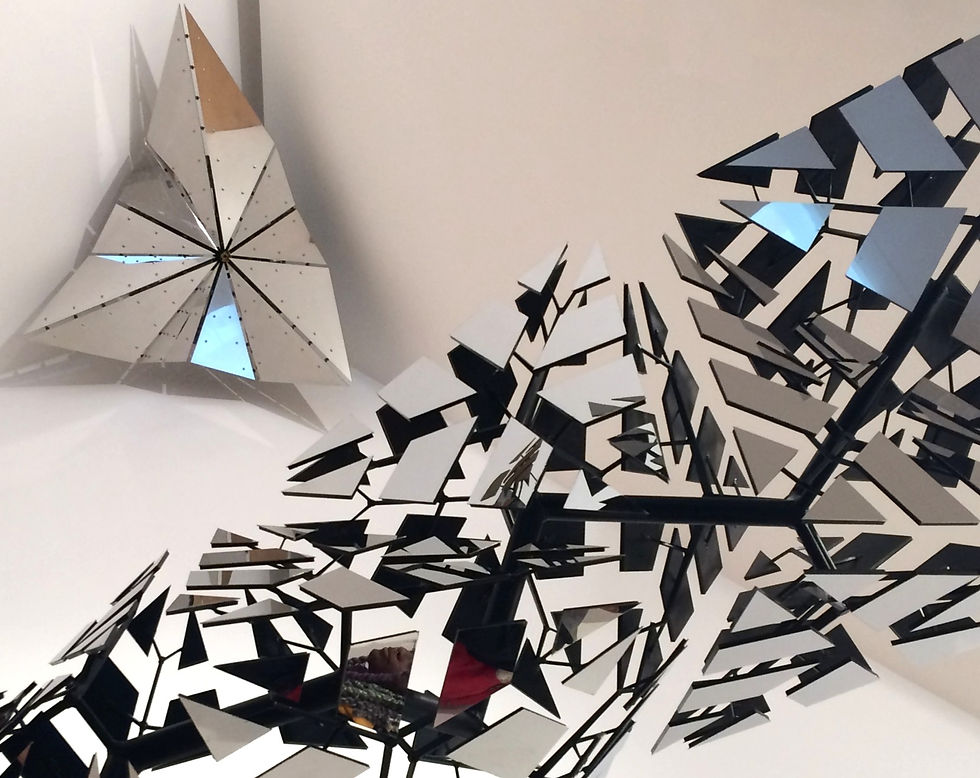
Upstairs, among chrome-polished futuristic sonic sculptures, we can find another statue, a kind of counterpart to the woman resting downstairs. She is carved in Zebrino marble, turned into stone in a meditative pose, contemplating herself in a mirror. This appearance of coherence is however quite literally split in half, the sculpture consists of two separate parts, revealing a reflective interior surface. The room is illuminated by a huge panel of light spanning the length of an entire wall, reflected in a mirror wall opposite, and reflected again inside the sculpture, creating ephemeral repetitions, where no image or element is primary or original. Instead, sounds and images form interactive systems. Sound vibrations activate the hanging sculptures, which, as they move, emit sound and reflect light, again reflected by the multiple mirrors including the one inside the marble statue. Contrary to of the stable and unchanging character of marble, she can be altered by the slightest change in light emissions or sound vibrations. The entire environment is in constant flux, its reality is a largely immaterial series of interactions and repetitions.

What is the Real we are returning to here? Aitken is far from suggesting any kind of romantic Rousseauian return to non-technological, premodern, pre-civilizational reality. On the contrary, he seems to point to the new digital landscape as some kind of Real. Maybe, as everything merges together and one can no longer make out the boundaries between image and reality, sound and motion, original and copy, the artificial divisions of rationalism and dualism dissolve, and we encounter a new Real in this fluid totality.


Comments