
Dancing in the Styx: Mark Bradford's 'Cerberus'
- Maria Kaminska

- Nov 25, 2019
- 3 min read
Mark Bradford’s exhibition at Hauser and Wirth is a collection of the artist’s new work, consisting of a series of paintings and a film piece.
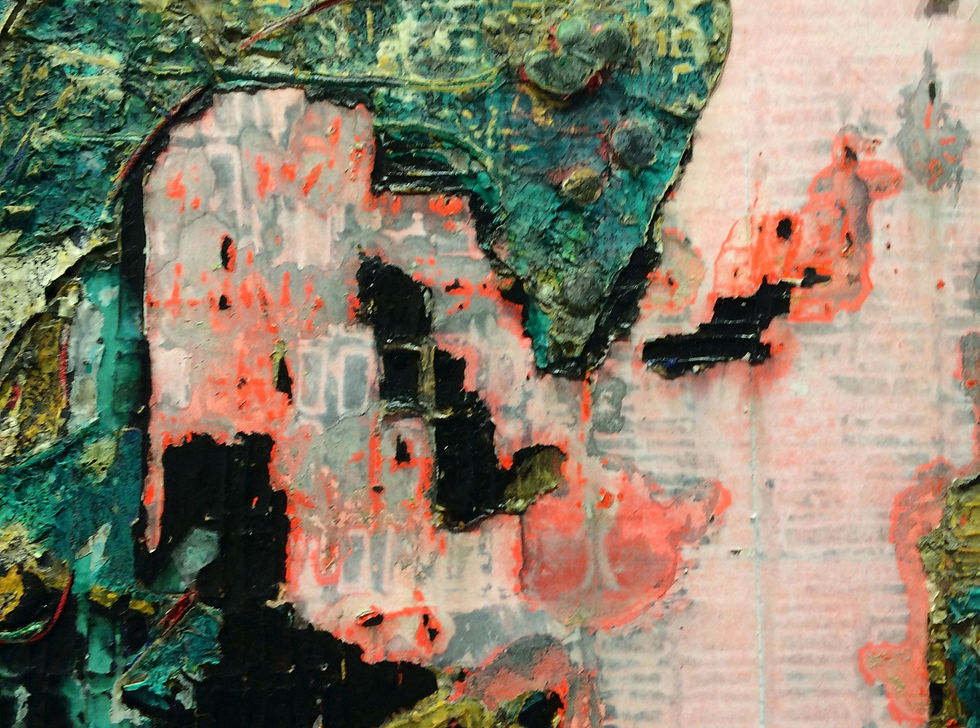
Bradford’s signature monumental paintings are composed from layers of paint and paper, stripped to reveal transitions between strata, likening them structurally and visually to maps, terrains, networks or city spaces.
The film piece entitled ‘Dancing in the Street’ is an intertextually cinematographic registration of urban space, filmed from a window of a car projecting Martha and the Vandellas’ ‘Dancing in the Street’ onto house walls as it drives through the industrial areas of south Los Angeles.
The overarching title of the exhibition – Cerberus – suggests an interest in the space and state of the inbetween. Both the boundaries between abstract territories in the paintings and the interstitial spaces of LA become a kind of gate, a space of transition.

In social consciousness the song (first released in 1964) has an unbreakable link with civil rights movements and riots. Dancing in the streets has a very specific meaning, as does the site it is projected onto, where the musical performance overtakes the topology of the city.
It is however a ghostly kind of detournement. The streets are not stormed by dancing rioting crowds but by an unstable moving image projected from a van and a hauntological sound recording.
The entire film has a kind of prologue//epilogue poetic, which evokes the myth of journey into the underworld, suburban streets become a passage, a transition, a descending. That epiloguish character is also enhanced by the cinema room's presence within the entirety of the exhibition - the sound coming from behind the wall could easily be accompanying rolling credits after a film.
What adds to this eeriness is a moment at the very beginning of the recording, where a grumbling sound of the car's ignition precedes the cheerful song in an odd dissonance.
That moment is a kind of glitch, where reality does not properly start yet, the interstitial space before the projection kicks off. The periphery in the film is both a beginning and an ending in a perpetual cycle. The journey of the van in which the camera is situated is not complete, does not reach a final goal, instead it is stuck in a haunting loop.
Projecting the song onto the street highlights a nagging disjunction between the signifier of the streets the song lyrics refers to and the signified physical space of a street. A tautological attempt to bridge the gap between the two paradoxically highlights its depth, and is thus stuck in the inbetween.
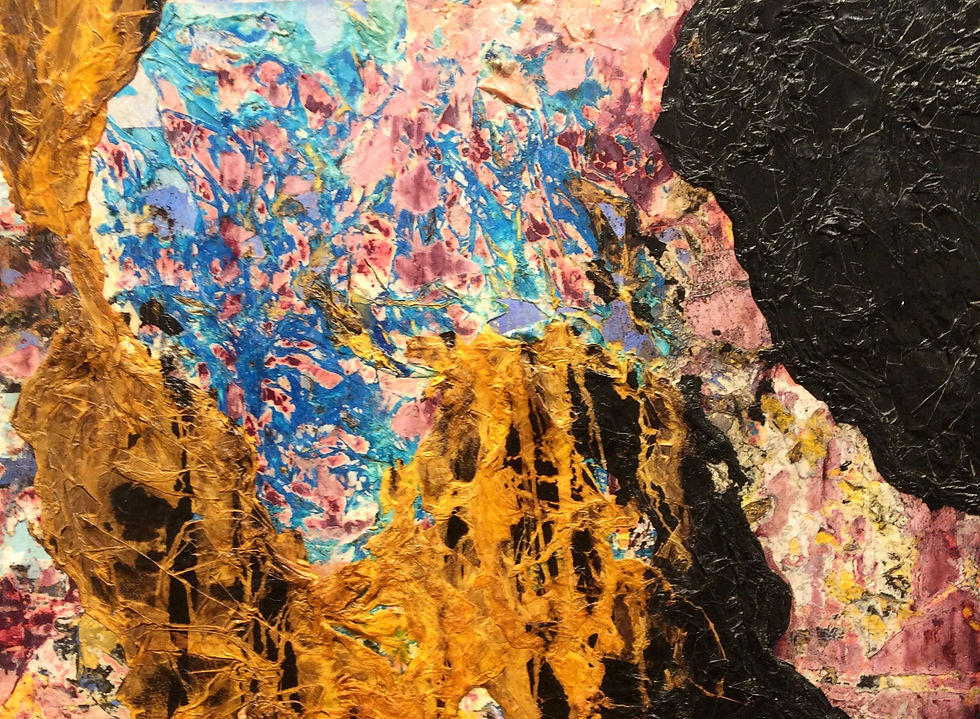
Though the connection between Bradford’s film and the paintings may initially seem quite puzzling there is a structural affinity between the two. The main process structuring the film is layering, which is the usual mode of work for Bradford in painting.
Layers of pigmented paper are accumulated and then revealed by stripping the surface of the canvas. The point of interest in these images is not figuration but the interactions between the territories, the boundaries and the electrifying effect of places where they meet and clash. The subject is still boundaries, gates and transitions, as a masterfully registered action. So, for example Cerberus depicts the process of a Cerberus rather than an image of a three headed dog. Still, mythology is quite conspicuous in the titles. The mythological aligns itself with the postapocalyptic and the prehistoric in pieces like A Five Thousand Year Old Laugh, evocative of a kind of primordial soup, a space of potential, but also a territory of conflict.

There is a certain hostility contained within the jagged forms of the paintings. The transitions, borders are indicative of an incomplete state, an instability of transition. More concretely however, one certainly cannot deny that Bradford’s paintings are also maps, territories – thus the mesmerizingly vibrant pigments become populations contained within a structure of power, a topographical grid. The webs, networks bear a “searing intensity of a chemical reaction or a process of oxidation”, maps are punctuated with hotspots, energy releases catalysed by breaching a barrier, crossing a gate, traversing a border, electrifying a space, by dancing in a street.


Comments