
Is There No One in the House? Surrealist Deserts, Empty Houses and Quantum Incompleteness
- Maria Kaminska

- Apr 16, 2019
- 3 min read
One of the staples of surrealist painting, especially that with oniristic influences, is the presence of vast empty planes. Whether it's Magritte's perfectly rendered seascapes and impossibly smooth surfaces of buildings or Dalí's glass deserts of paranoia, the landscape of the surrealist unconscious seems very often to be a perfectly flat and eerily desolate plane.
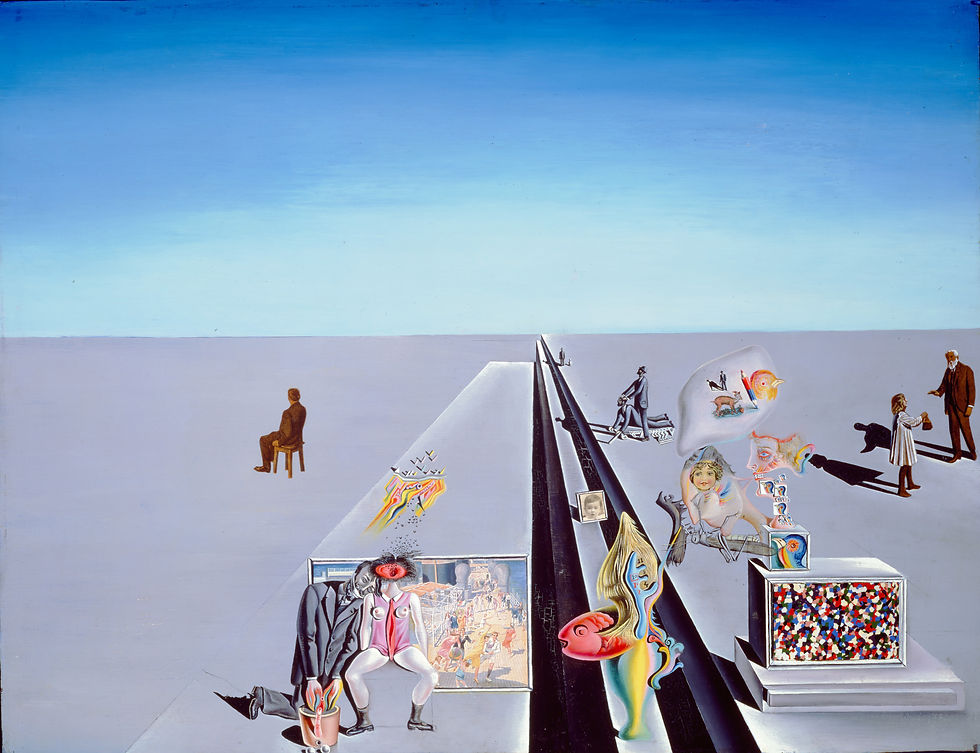
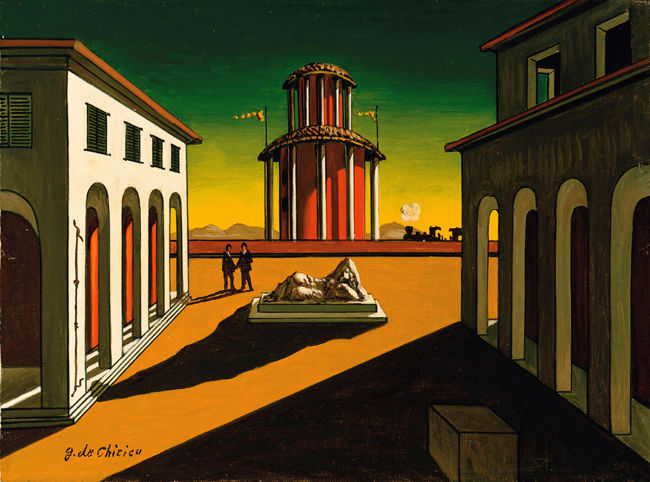
I am not quite sure why that is, but I'm fairly certain that it's not just a kind of bandwagon effect with no particular meaning. Rather than that, it seems to be one of the essential qualities of such paintings - a large part of the feeling of the surrealist hyperreal may well be a result of such manipulating of space. One completely unscientific hypothesis could be that it looks particularly oniristic because the perception of space in dreamscapes is, in a way, constructed, and maybe this simplified rendition of ground and sky is the best our brains can churn out at times. Or maybe it's a bit more symbolic than that, maybe its something completely different. I don't think anyone's done any significant research in the field. Either way, there is something in this type of landscape. For one, they look very artificial, very unreal and yet are painted in a very realistic way. This is a similar mechanism to the one employed by de Chirico in his modifications of space through smuggling perspective contradictions under the coat of trompe l'oeil realism into his architectural landscapes (as described by Rudolf Arnheim). By creating constructions that are seemingly realistic through obeying some rules of perception and then violating them in a deceptive way, surrealists manage to create a kind of hyperreality - something that is perceived akin to real world sense data, but in fact is thoroughly imaginary.
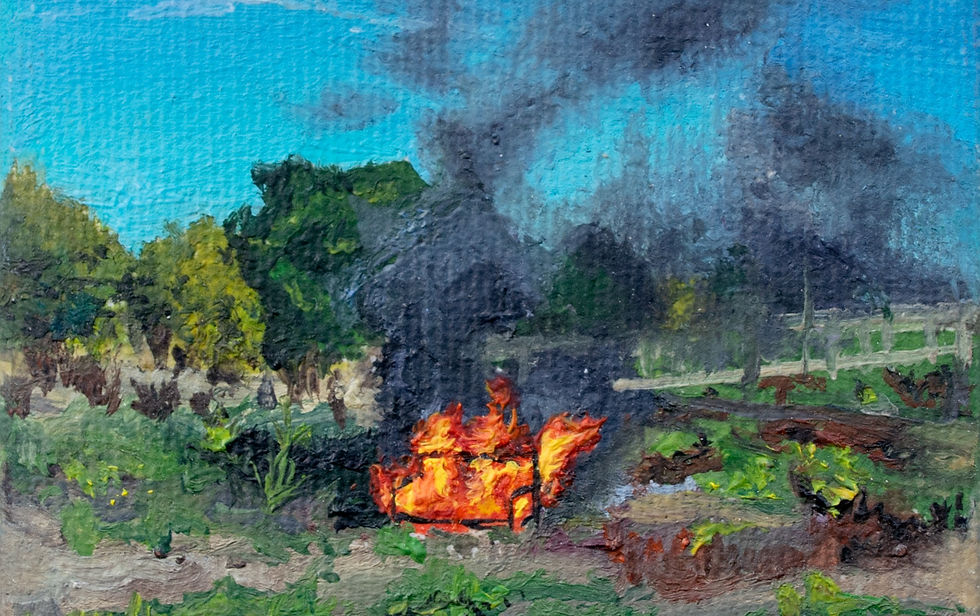
This notion of places or situations that are realistic but thoroughly fictitious, has, along with some other interests (most importantly the hypnotic appeal of danger, the representational paradox of figurative painting, and mixing distress with absurd) taken form in a series of works I have recently painted. All of them depict a house, a very realistic but an obviously fake one - it was painted based on a cardboard model of a house made from memory and imagination, without referring to any outside sources, other than (and very roughly still) another painting I have done. All the houses are on fire - well, not entirely so, the fire is even more fake than the houses themselves - it is nothing more than a painted copy of a printed picture of a fire inserted into the model house's windows. And perhaps the most important part is the kind of non-place where they are situated - in most cases an absurdly bright green flat surreal plane.


This idea, though tied in very obvious way to what I've talked about above, has some other connotations as well. The landscapes have the look of a computer game, even more so, of a beta version, of something not quite finished, or already unraveling, disintegrating. This is also the idea behind a very intense focus on the surfaces themselves. I should probably admit that I've stolen that, at least in part, from Žižek (who may well have been quoting someone else, to be entirely honest). In one of his lectures, when talking about quantum uncertainties, he recalls a parallel between our universe as an unfinished project and a computer game, in which some parts are not fully programmed. Whether it's the mountains in the background that you can never get to, because they serve only as a decoration in a fantasy game, or a shed that you cannot enter and may only use to hide behind in a first-person shooter, the space is not fully programmed, it is, in that way, incomplete. And, it may well be that our situation in relation to for example subatomic particles, or scientific knowledge in general, is analogical - we can get to a certain point, but no further, and perhaps not even due to some empirical or transcendental impairments, but because the universe is programmed in that way, that is, a priori incomplete, because there is nothing inside the house.
And while I do admit that I have quite a problematic relationship with regarding my work as a kind of philosophical metaphor, I cannot deny the appeal that the above idea has for me, as much in theoretical terms as it does in aesthetic, or even poetic ones.

Comments