
Domestic Disharmony
- Maria Kaminska

- Mar 20, 2019
- 2 min read
Updated: May 3, 2019
Recently I had the brilliant opportunity to display my work in an exhibition in the Unify Gallery in Farnham, alongside some amazing work by other students. Probably because of my house obsession I was approached by Catherine (check her out! ), the curator, who told me she was organizing an exhibition centering around 'the uncanny of the home'. And thus the artworks ranged from large-scale paintings and sculptures of shells, through wax sculptures of household items, to poetry painted onto or bleached into bed sheets.

The interesting thing about the main theme of the exhibition is that, in certain etymological terms, the uncanny of the home is almost a pleonasm. The concept of the uncanny can be traced back to Freud, who, though not its original coiner, is regarded as one of the its main proponents in modern and contemporary aesthetics. And in his essay on the subject, he not only underlines the original meaning of the German word (usually translated into English as uncanny) unheimlich, which in literal translation means unhomely, but also points out that in its antonym - heimlich there is a shade of meaning which merges with its opposite. The dictionary entries he recalls extend the notion of heimlich as homely and domestic further towards something intimate, removed from the eyes of strangers, clandestine, hidden, secret. Using this as suppport for his investigation, Freud goes beyond the usual notion of the uncanny simply understood as the unfamiliar, rather, he goes on to explicate how the it is specifically that which, once familiar, has become unfamiliar, or repressed.
I this way, this very specific genre of the frightening can be shown to have a very strong connection to that which is the closest to us - it is not the horror of the unknown, but that which suddenly becomes alien, hostile, rebels against us. And is there a better example of this than haunted houses?
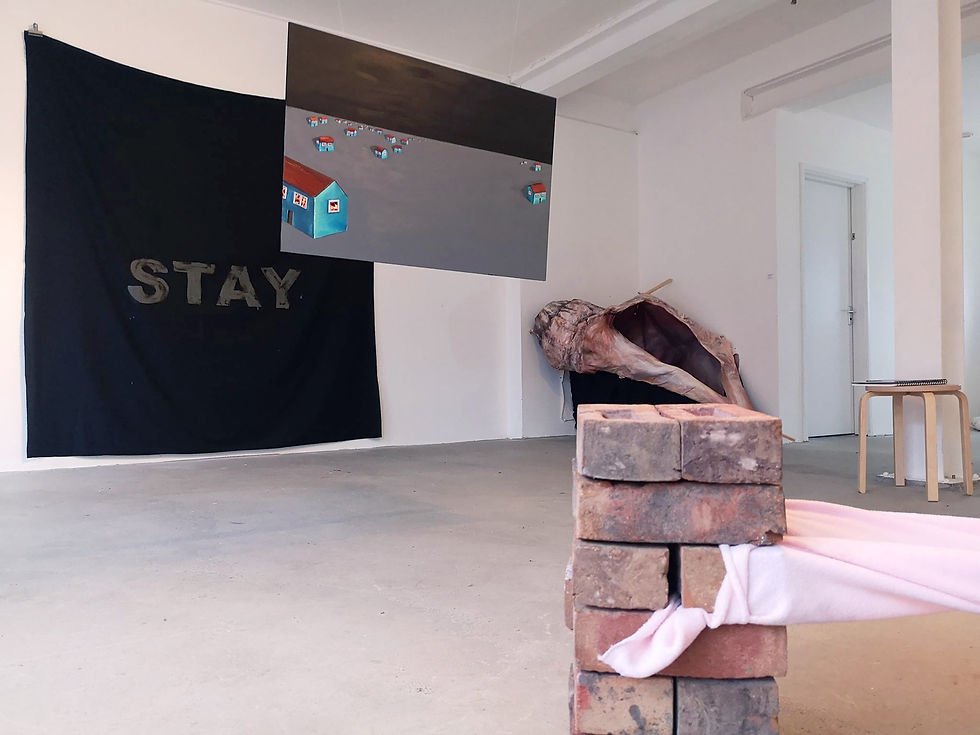
Some of the artworks displayed in the exhibition made use of that mechanism of unfamiliarity resulting from familiarity - for example a wax soaked tablecloth, seemingly mundane, but after closer inspection noticeably defying the usual laws of physics to which fabrics are subjected, and giving off an intense smell. Even more so, however, our works have played on this notion of hostility of the repressed in which objects become imbued with what seems almost as a will of their own (a classic mechanism in gothic and horror fiction, and one of the main premises on which their haunted houses function) - a shell and a hand protruding from the wall, a painting of a self-replicating house, mindlessly copying and pasting itself over a desolate plain like a virus, a black bed sheet , calling you to STAY in block capitals bleached into its middle.
Most interestingly however, the exhibition had one more, non-Freudian extra flavour - that of the absurd. The whole collection of artworks and objects which have undergone inexplicable transformations in size, substance or function resulting in paradoxes like a construction of bricks that can be knocked down with a tug of a blanket or a wax clothes iron that would melt into a pile of hot wax if one were to put it to use.
Comments